
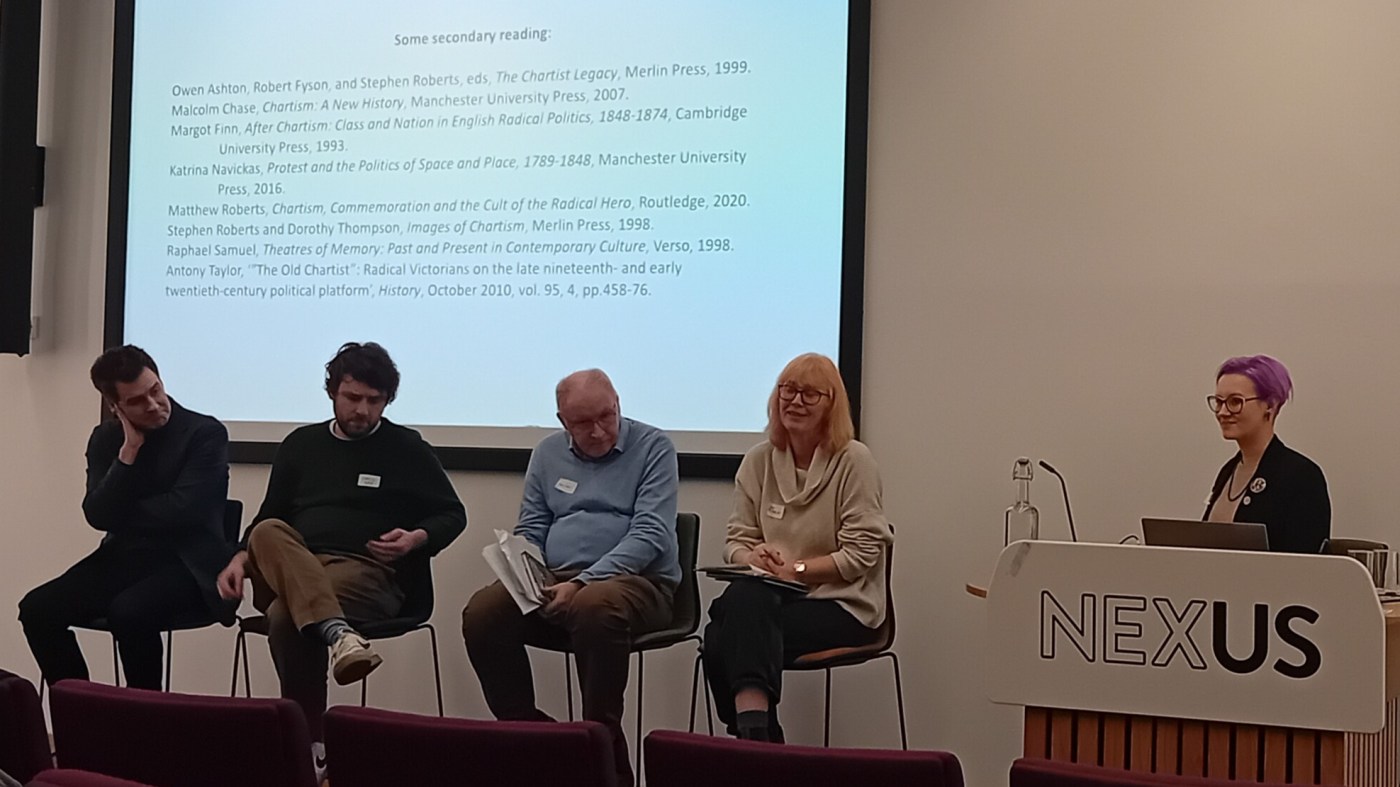
On Friday 29th November, a symposium in memory of Malcolm Chase was held by the University of Leeds, entitled Radical North: 1779-1914. Malcolm was a social historian and the leading authority on Chartism, publishing definitive texts such as Chartism: A New History and Early Trade Unionism: Fraternity, Skills, and the Politics of Labour.
Birmingham People’s History Archive have been honoured to receive a wide range of books, pamphlets, and posters from Malcolm’s estate, and it was likewise a privilege to be in the audience for this series of panels and roundtables dealing with everything from the pre-Chartist Radical tradition to the legacy of Chartism itself, as well as numerous speakers and audience members recounting their memories of Malcolm as a friend, colleague, mentor, and scholar.
Papers opened with Callum Manchester (University of Cambridge) providing a timely reminder of the importance of situating the term ‘radicalism’ in its proper historical context. The shifting nature of ‘radicalism’ was a thread that ran through several of the subsequent talks—Henry Miller (Northumbria University) spoke, for example, on the changing nature of petitioning in Britain after 1850.
Attention was also given to figures in the radical tradition such as Thomas Spence, John Marshall, and Thomas Dixon; Vic Clarke in particular, in a discourse on Richard Oastler, sparked lively and extended discussion on the notion of ‘Tory radicalism’—an ideological space where Oastler is joined by, amongst others, figures like William Cobbett.
Malcolm was without exception remembered by the speakers for his kindness, generosity, and compassion, and as well for his principled and ethical leadership.
Robert Poole (University of Central Lancashire) referred to Chase’s determination to understand the past on its own terms, stating that this was the reason he has left such a legacy. Joan Allen (Newcastle University) and Katrina Navickas (University of Hertfordshire) both emphasised his ability to carve out new spaces of research, his generosity in sharing that space with colleagues, and his commitment to outreach to the general public.
Matthew Roberts (Sheffield Hallam) praised Chase’s rehabilitation of Feargus O’Connor as the foremost leader of the Chartist movement, and lauded his success at producing a single volume on the history of the movement from its birth to its demise (Chartism: a New History). His conclusion was a worthy summary of the sentiments of all: “Radical history is all the richer for Malcolm’s intervention; all the poorer for his untimely demise.”
Malcolm’s legacy is indispensable for our work at the BPHA, and we are proud to have a hand in preserving important documents from his library and personal materials, as well as in continuing the important work of popularising Chartist history—“the finest hour of the working classes”.
 Birmingham People's History Archive
Leave a comment