
Birmingham Heritage Weeks September 2022-2025
This September will be BPHA’s 4th event for Birmingham Heritage Week. Despite the huge amount of preparation, on the day it’s worth it and lovely to welcome so many new visitors to the archive. Numbers attending go up each year, and we have great feedback.
Book your place at one of our three sessions on Saturday 13 September See Birmingham Heritage Week – 12–21 September 2025 Booking opens on Saturday 9 August at 12 noon. There’s no charge but we’d welcome donations – we’re volunteers with no institutional funding and all money raised goes towards room hire, archive-quality storage and development. If you’ve any questions about the day, please email gill@bpha.online We look forward to meeting you there!
Here’s the story so far.
- 2022: We had a small-scale display and tours of the archive room. BPHA had only moved to city-centre Birmingham & Midland Institute two weeks earlier, from an upstairs room in Balsall Heath.
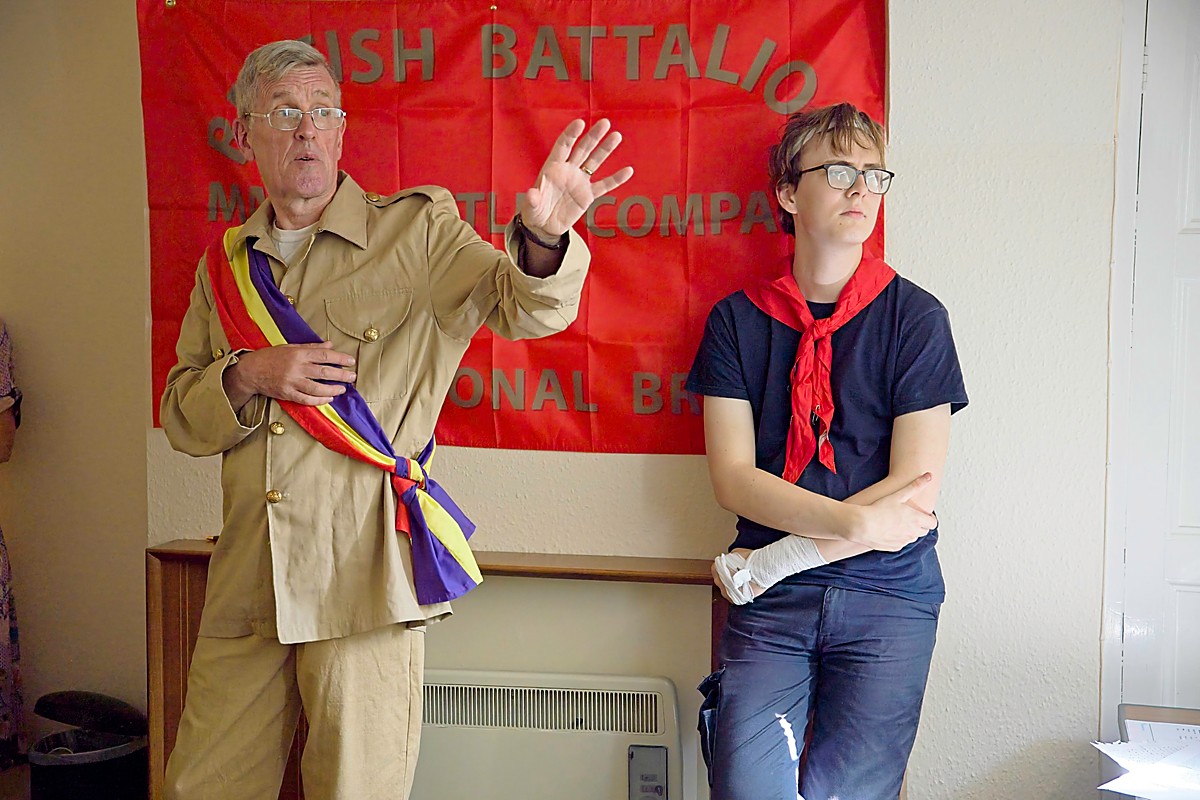
- 2023: The exhibition was much larger, based on an Everyday Heritage grant awarded to BPHA by Historic England. Displays, including audio-visual, showed how the grant enabled University of Birmingham students to interview retired industrial workers. Art work by school pupils, including wall hangings, showed how the interviews and research had been used in collaboration with a professional artist. There were displays showing other grant activities and products, like our community trip to a Nottingham industrial museum, and a map of mostly now vanished industrial sites. By now we had two archive rooms. As well as tours, visitors took part in a living history workshop on the Spanish Civil War. They saw BPHA’s resources about the conflict, learnt about Birmingham citizens who fought for the Republicans, and finished by singing Jarama, a Republican song referring to the Battle of Jarama 1937.
- 2024: Our exhibition, tours and living history workshop focused on post-World War Two Birmingham. We included displays of recent donations to the archive, such as the Albert Knight collection; he founded the Central Labour College (1909-29) and visited the USSR in the 1920s. There were photographs from the 1950s-70s, showing bomb damage, demolition of historic buildings, and the reconstruction of Birmingham city centre and beyond, with ring roads, subways and new estates with tower blocks. The 2024 living history workshop was about the historic 1945 election – featuring Ian, Monisha and Daniel (volunteers) as three fictional, local characters with different views. The longstanding west midlands MP wanted Winston Churchill and the Conservatives to be re-elected, based on his wartime leadership of the National Government. A much younger volunteer played a wounded ex-soldier; the MP had refused to re-employ him in his factory but gave him some work as a political assistant. He held up signs behind the MP, doubting the promises being made. Thirdly, a woman whose young child was in a government-sponsored nursery during the war, enabling her to go out to work, argued for the Labour party, led by Clement Attlee, and its proposed reforms, including the NHS. In her words, ‘Churchill’s done a great job leading the Allies, and defeating Hitler… but we want a new, different Britain, a new, different world.’ The audience then joined in singing Jerusalem, a song often heard at the end of Labour party conferences, but with wider appeal and aspirations.
- 2025: This year, there’ll be an exhibition and living history workshop on the Labour party response to the use of nuclear weapons at the end of World War Two. We’ll look at our archive materials, and find out about Birmingham events and people, including VJ Day (Victory over Japan) 80 years ago. We’ll consider how this affected the UK’s relationship with the USSR, USA and Europe, the beginning of the Cold War and development of NATO. Our living history workshop, set in the 1960s, will compare the views of politicians who made decisions about Britain’s nuclear programme with those of the newly emerging CND (Campaign for Nuclear Disarmament). In doing so, wider views about the ‘nuclear deterrent’ and disarmament can be explored. Audience participation required, in singing at the end of the workshop!
See you then!
 Birmingham People's History Archive
Leave a comment