
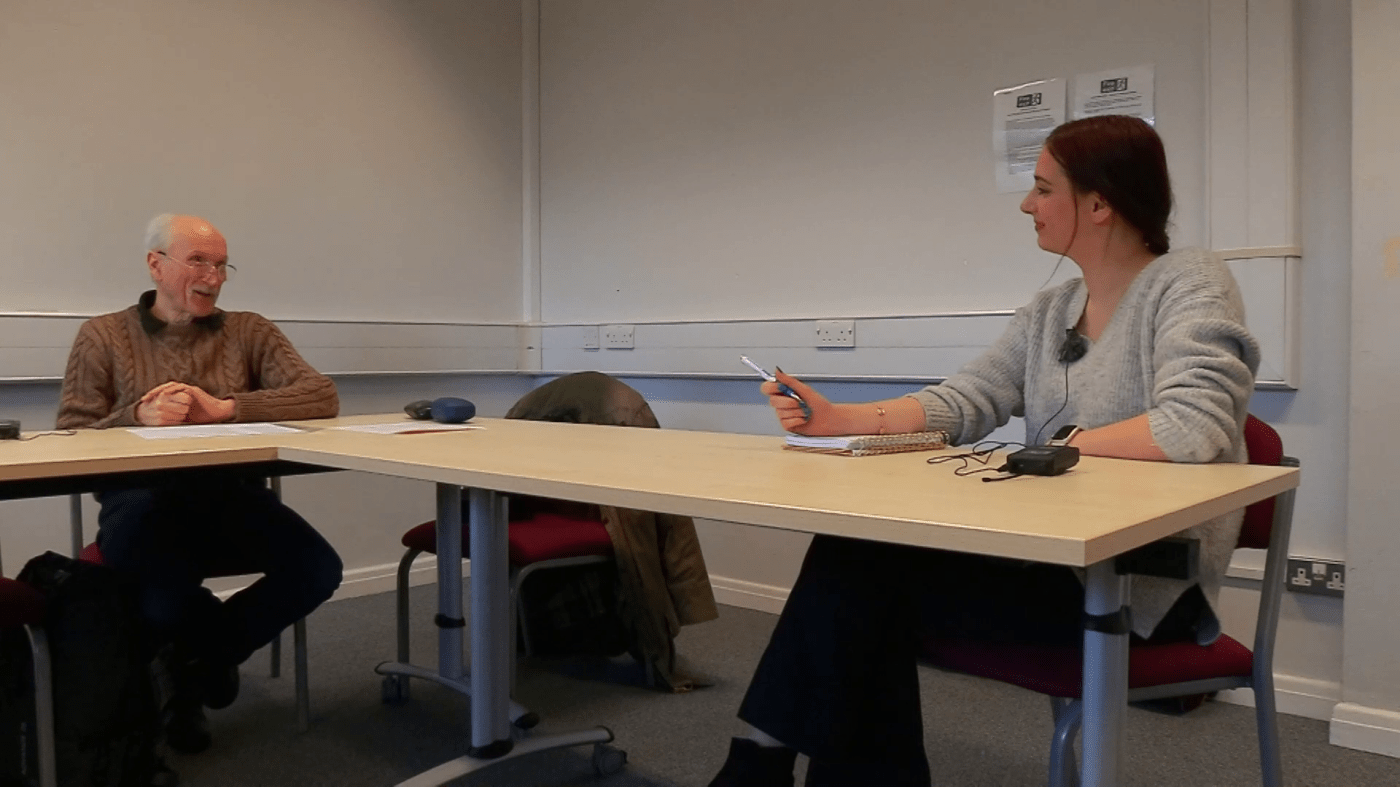
The following is an interview conducted by Charlotte Langrish as part of the BPHA’s Historic England oral histories project, on 26 January 2023.
If you are a retired worker in the West Midlands who would like to tell your story, or if you know someone with a story to tell, get in touch with us at gill@bpha.online.
CL: I’m Charlotte Langrish…
JW: …and I’m John Worwood, and my usual pitch at this stage is my surname rhymes with the motto of the city of Birmingham, which is ‘Forward’ so I usually say as an icebreaker, “Let’s go forward with Worwood!”
CL: I’m gonna start with your early life, so can you tell me a bit about where you grew up?
JW: I was born in a Solihull hospital, because my parents at the time were living at Hampton in Arden and very shortly afterwards they moved to Hall Green in southeastern Birmingham. I went to a primary school in Hall Green and I passed the 11 plus and I went to George Dixon Grammar School in City Road. All the way from Hall Green was a bit of a march, but I’m glad that I went to George Dixon. As a selected grammar school, it gave me a great grounding. So we lived in Hall Green up until I was about 21. I think when my parents moved over from Hall Green to Edgebaston, which was undergoing a lot of change with the redevelopment of the Calthorpe Estates to make it more people-dense. In other words, the large freestanding buildings were being knocked down because they were all leasehold and the whole site being redeveloped with more modern houses, smaller houses.
CL: I’m just gonna quickly go back to your family. So what did your parents do?
JW: My mother was a housewife as they were in those days and my father was a sales manager in modern speak for a tyre distribution company called A-1 Tyres in Broad Street and I do have a photograph of it, of A-1 Tyres…I came to university in ‘65 to study electrical engineering and my father started his own business in about 1966 doing the same thing, Worwood Tyres in Handsworth, and that is what he continued to do until he retired. My grandfather, my paternal grandfather, had been a silversmith in the jewelry quarter and his father had been a brass founder. So we come from over 200 years of a line of Brummies who lived in the Aston / Lozells area. So I feel myself hefted to Birmingham like the herdwick sheep on the fells…
CL: There’s something pulling me back here. Did you always know then that you were going to take inspiration from your father and go into a similar sort of trade?
JW: No, the reason why I joined Dunlop was slightly serendipitous, I suppose. When I graduated with a degree in electrical engineering from University of Birmingham there were loads and loads of jobs for graduates and so I, on the milk round which I don’t know whether still exists, but you used to go and be interviewed by various potential employers. And I was interviewed by GKN IMI because I wanted to work in Birmingham and there were plenty of opportunities, and Dunlop as well. And out of the companies that I went for interview Dunlop had, or seemingly had, the most opportunities of working abroad, and I thought this sounds a jolly good idea. Somebody is going to pay for me to work abroad! Now initially I would have liked to work abroad in either Dunlop France or Dunlop Germany because I have always been a Europhile and feel totally at home on the continent, and at school at George Dixon I not only did French but also did German. So I felt happy in either place. In the event as I said after a while at Fort Dunlop I went to Nigeria, but I did have the opportunity to speak French and German because I joined Lagos Yacht Club and there were a whole raft of all sorts of different nationalities. So I was able to speak to them.
CL: So your French and your German that you learned at school came in handy then. Was there anything else that you learned, particularly at secondary school level, that helped you with your career later on?
JW: Off the top of my head, no, I really can’t think of anything particular. No, the important thing was that I had a good and standard O level, A level, then university, it gave me stepping stones to go to university and I was – I still am – the first one ever in our wider clan that went to university. I even beat my cousin who is a year older than me because he fluffed his OA levels.
CL: What do you think the drive was for you to go to university?
JW: Two things – (a) because my parents wanted me to, and (b), because I wanted to study electrical engineering which I had got interested in as a hobby as a teenager
CL: So when you when you studied electrical engineering did you know what sort of trade you wanted to go into?
JW: Well, no, but as time developed I realized that I wasn’t out of the absolute top draw in terms of electrical engineering. I realized I was not research material and maybe not material for going into an electrical manufacturing company, of which there were many in the UK when I graduated, but I thought I would like to use my electrical engineering as part of the infrastructure of manufacture, and if there are two things tattooed across my heart, one is Dunlop – because I feel very kind towards Dunlop because over the years they treated me quite well, although I didn’t always literally work for Dunlop – and secondly, I’ve lost the thread –
CL: You’ve got…
JW: …oh, got Dunlop tattooed here and also manufacturing tattooed here.
If I get the opportunity to go around a factory, that’s me right in the front of the queue. I feel particularly hard done by what was done in this country in the 1980s and 90s in terms of dismantling manufacturing and basically saying this is old hat. We ought to be manufacturing more in my opinion and recent events have shown that it was not a good idea to go and offshore everything.
CL: I’d love to delve more into that in a bit. But I’m gonna go back and ask if you could tell me about your first day then working at Fort Dunlop
JW: Right. Well, I went to work for Dunlop at Fort Dunlop in September 1968 as a graduate apprentice That’s what the half dozen of us engineering types were called. I was one of a large intake of graduates. I think there were about 50 of us, and as I say there was no difficulty getting a job. Our first day was spent actually at the Grand Hotel Colmore Road in the center of Birmingham for a sort of an induction day, lifting us down gently. The subsequent induction was at Fort Dunlop, and instead of being released on to the canteen system at Fort Dunlop we were actually taken by coach to the Linter’s pub in Erdington, where there was a massive lunch laid on for us.
Subsequently, we were allocated to the various places. There were five or six of us. One or two others were graduates and two or three others weren’t. We were located in the apprentice training school at Fort Dunlop and the first few weeks we did what all engineering apprentices did and that is fitting, and we were issued with six files and a ball peen hammer, I haven’t brought them with me. I still have them and we had to make some items and I have brought one of the items that I made which is a screwdriver. That involved filing the tapers on the handle, filing these shoulders…the separate shaft had to be forged into the end to flatten it out and then after doing that you had to drill the handle to allow the shaft to go inside, had to make a metal cap to go because this is hollow inside, this brass handle. File this hexagon piece for the top, then you have to assemble it – the shaft goes into this wider hole that’s been drilled and reamed inside the handle and is held in by what’s called silver solder, which is a high temperature solder, and then the other end you’ve got the lid to trim on this handle that is soft soldered…Reason for that is, that the hard solder won’t melt at anywhere near the temperature that soft solder melts. I also made a tap wrench, that’s for tapping threads in holes. But unfortunately, I couldn’t lay my hands on it. Otherwise, I would have brought it.
CL: So did you did you steal that did they know that you took it?
JW: Mine to take away. Yes, very nice, got my initials JW on there.
CL: So what’s that the first thing you made?
JW: I think the first thing that I made was a filed block of steel which had to pass muster in terms of square and so forth. Yeah, but I think that’s the first object that I made.
CL: Did you feel like they gave you enough sufficient training to sort of get stuck into the job? Or did you have to learn things as you went?
JW: Oh no, this was to give us an absolute basic grounding in what everybody else was getting. This is the craftsman, the tradesman. We were there I think six or eight weeks, something like that. While I was a graduate apprentice we were also sent up to Manchester to what was then called John Dalton College of Technology, where we had a two-week course on rubber and plastics technology, learning about the theory and then actually doing it in the laboratory, making inflatable rubber duck or floor mats or tubing or whatever. They didn’t make tyres because that was far too complicated for a college.
CL: It sounds like you had a very social workplace. I know that Dunlop was a very big factory, I think one of the biggest in the world at one point –
JW: It was the biggest tyre factory in the world at one time.
CL: Yes So did you have a lot of friends there?
JW: To be honest, no, I was friends with the people who I joined with who were the other engineers. We did do a bit of socializing with some of the other graduate intake but Fort Dunlop had got lots and lots of people who were relatives. They were, you know, wives, children, uncles, aunties, and all the rest of it, and I didn’t. Although it had got over 10,000 employees to the best of my knowledge, there was no relative of mine there. I didn’t know anybody and because we were the graduate intake we did have a bit of baggage to overcome with the people that had been there for years. “You’re coming to me to get my knowledge.” Nobody actually said that, but that’s the impression that you got sometimes. The other thing, in the 1960s, there was very much a divide between staff and shop floor, and as the graduates were staff we were expected to wear suits and of course as soon as you walked anywhere, “Eh, you’re staff, what are you doing here?!”
CL: Could you tell me a bit more about that divide there?
JW: Oh, it wasn’t hostile or anything, but you knew that people knew you were around. It was difficult to fade into the background as it were. That’s not necessarily been the case – not at all the case – for most of my working life, because the rigid divide between shop floor and staff and level of union membership and all that sort of stuff has changed dramatically during my lifetime, but I think pretty well everybody on the shop floor certainly and a portion of the staff at Fort Dunlop when I started in 1968 were in unions. I mean there were two unions – a general and municipal workers and I think it was the transport and general. I’m not entirely sure which the unions were but there were two, as well as all sorts of bits and pieces for the engineering people and so on and so forth, because unions were very disjointed. Depended on what size paintbrush you used as to which union you were in, whether you’re in the painters or something else etc. I say there was a sheet metal workers one and goodness knows what.
the rigid divide between shop floor and staff and level of union membership and all that sort of stuff has changed dramatically during my lifetime, but I think pretty well everybody on the shop floor certainly and a portion of the staff at Fort Dunlop when I started in 1968 were in unions.
CL: Were you part of any union?
JW: No, no never been in a union in my working life. No, obviously in the NUS when I was a student but I never needed to be.
CL: Would you mind if I asked a bit more about this?
JW: You can ask
CL: So how many unions did you say there were?
JW: Oh, I would say there were two big ones for the rubber workers, I can’t exactly remember the names of them because of course all these things have changed in name. There was one for the engineering shop floor and then there was a multiplicity of tiny bits and pieces. And there was one for staff which not all the staff were in by any means. And again, I cannot for the life of me remember what that was.
CL: How do you think this affected the factory?
JW: It did affect the factory, although of course being green behind the ears at the time, newly starting in the huge organization, you weren’t directly affected by that sort of thing. I mean it’s in looking back in retrospect on some of the other jobs that I have done in my working life, where there were unions like, not being able to carry a ladder somewhere or having to be circumspect when you’re walking through somewhere because people didn’t like being looked at, that wasn’t necessarily the case at Fort Dunlop because when we walked from the apprentice school to the canteen we always used to walk through the factory and watch people doing stuff. I mean some of the tyre builders were absolutely amazing, they were like ballet dancers, and we always used to have a look at them, make sure that we went that particular route.
CL: There’s a few things which I would like to go back and touch on a little bit from what you said. You said that a lot of people had relatives that also worked in Fort Dunlop. I’m thinking more about the women here, what sort of roles did they take on?
JW: In 1968, almost exclusively administrative, in the offices, secretaries. There was, in the commercial office block, of which I do have a photograph, there was a whole floor of the commercial offices, which was a massive typing pool full of ladies pounding typewriters. When I got to Fort Dunlop, the system was if you wanted anything typed you wrote it by hand, handed it into the secretariat, as it was called, and then it came back. There were people employed to collect work and bring it back to you. It was also in 1968 the case in the offices that a lady came around with a trolley with drinks in the morning and in the afternoon. But they also took trolleys of food around the factory.
The canteen and catering was a massive activity for that number of people, especially on three shifts, so they had a small fleet of converted ice cream vans for doing some of the outlying parts of the site, and at a certain time there’d be a fleet of ladies with trolleys going from the canteen into the factory through the departments with food for people.
So that was another area where women were employed. There were still one or two women actually in the factory, in what’s called the bead section, beads are part one of the components that are required in making a tyre. Of course in the Second World War there’d been loads of women working in there, but subsequently not so.
CL: What were the working conditions like?
JW: In most of the factory they were quite decent for the time. In the rubber mixing department called the mill it was filthy, particularly because rubber is mixed with something called carbon black, which is in effect soot. And you know how soot adheres and gets everywhere. I always call it the dust that reaches parts that no other dust will reach. It was filthy in there. You would walk through even superficially and you’ve got dirt around your collar, if you were in there for eight hours then you would be dirty and needing a shower, which were provided. Clothing was provided, there was an on-site laundry for work clothing, I mean the site was pretty well self-contained, none of this outsourcing, everything was done on site including typewriter repairs. There was a massive department just doing that.
CL: I’ve got a bit of a two-fold question. One, if you could estimate how many different sections there were? Would you be able to give me a ballpark?
JW: With all the outlying bits, with the test house and test track and the typewriter repairs – they did instrument repairs and making new instruments, the laboratories and all the rest of it – I bet there were at least 40 places on the site. It was huge, with all these little bits around it.
CL: Did you get to choose which section you worked in?
JW: No, after we finished with the apprentice school we were allocated places. I was allocated a place in an organization called tyre engineering services. This was the Dunlop department for want of a better word, that gave worldwide factory engineering support, so I was in the electrical section of tyre engineering services.
My main activities were on two things – one was on the expansion of Dunlop Nigeria. They were spending some money on building a new building and equipping it to make truck tyres, radial truck tyres, which had been developed in the UK. Also, I was part of the project building a new tyre factory at Washington, just south of Newcastle. So other people might be dealing with factories in India or South Africa or New Zealand or wherever else it happened to be, because Dunlop had factories all over the world, both tyres and non tyres. Tyre engineering services, as the name implies, only dealt with the tyre factories from overseas. There was another group, another department, that dealt with the non tyres – making the wellingtons and the hoses and rubber dinghies and whatever.
CL: Did you find every day was quite similar in routine in tire engineering services?
JW: Moderately, when I was in the office, which was most of the time, but we did have the opportunity to go off-site, out of the office, up to the Washington tyre factory and spend some time there. So had some hands-on activity up there, spent a good few weeks in total up near Newcastle, so I got to know the area a bit. Also, tyre engineering services always inspected large items of equipment at the manufacturer, before it was packed and shipped off to wherever it was, so I went to some factories and put my brass plate on this, saying inspected by J. Worwood on such and such a day.
CL: So just quickly before I return to what you were saying, that you said you moved on to more office work…
JW: Oh, that’s because as a graduate I was expected to be doing more of the theoretical stuff and I wasn’t expected to carry a bag of tools around. That was how things were then. I mean in Nigeria, I took my tools in on occasions, because we, in some of the projects, we just needed every pair of hands – even my incompetent slow hands, was another pair of hands to get one or two jobs finished. As I say, being staff, in 1968, there would be some resistance to the staff handling tools, putting it politely!
CL: Did you ever wish that you weren’t on staff?
JW: No, because I’m one of these people I do lots of practical things at home and have done ever since I was little and still do. In Nigeria I had the opportunity to use tools, and consequently things changed in the UK and there would not be opposition to people in suits with tools anymore, so it didn’t affect me later on.
CL: When you said you were an inspector for a bit of factories…
JW: I inspected items of equipment purchased for shipping out to overseas factories to make sure that the items (a) worked and (b) worked to specification.
CL: Okay so now I’m gonna ask a bit about when you went to Nigeria, what year was this?
JW: December 1970, just in time for Christmas.
CL: Whereabouts in Nigeria did you move to?
JW: It’s a place called Ikeja, which is just north of Lagos.
CL: And you stayed there for six years?
JW: Six and a half years, until May 77.
CL: And what was your primary job? Why did you move there?
JW: Because I was told by my superior at Dunlop that there was a vacancy for the factory electrical engineer in Nigeria and they thought it would be good for me to go, and I thought “sounds fine to me” and off I went!
CL: How was it to work out there compared to the UK for Dunlop?
JW: Well on one side, it’s just the same, because it smelt and sounded the same, the processes were the same, but of course, like that television program, you may have heard of it, it ain’t half hot! It’s hot in Nigeria because it’s in the tropical zone, the tropical forest zone, so it’s hot every day without exception and that’s the first thing.
And the second thing is, as I said to you before we started recording, I was 23. I was in charge of everything electrical in the factory and it wasn’t just a tin hut. It was getting on for a thousand people and there was quite a large sophisticated electrical distribution system, 11,000 volts and 3.3 thousand volts distribution system, which grew bigger while I was there. But all the people that I was the manager of, and this is the bit that they didn’t explain to me, they were all older than me and all Nigerians. As it happens, I got on well with everybody, Nigerians are lovely people and the blokes in the factory were pretty good. Like everywhere, you’ve got some that were right excellent people and one or two who were duffers, but you get that everywhere. But as a general crew they were very good, very supportive, and got on with what was required.
My fellow expatriate engineering department colleagues were all older than me, I was the only one that had a degree, so there was some comment about that and the fact that I was very young and that I hadn’t, you know, hadn’t been around much. So they came with entirely different sort of life experiences, compared to me I hadn’t got any or had very limited ones.
CL: Did that ever cause you difficulties?
JW: Not really, it was not done in malice or anything like that if it was said. These days maybe people might take exception to it, but it was totally acceptable as banter in those days, it didn’t bother me because I’ve always been my own person and got on with what I am supposed to get on with
CL: You said the sound and the smells were the same, could you paint me a picture of these?
JW: Right, well, a rubber processing and tyre factory has got a lot of big machinery in it. When I got there, I think the biggest motor was 750 kilowatts which may not mean much to you, but it’s quite big. Before I left we put in an even bigger one, a 1.1 megawatt electric motor. So when you’ve got big electric motors, there is a certain amount of sound from it. The machinery that’s driven from these big electric motors also makes some sound. When rubber is being processed it traps air and then all of a sudden it’s a bit like a balloon and it pops. So you get snap crackle and pop from the processing of rubber on some of the machinery. Then you have got a lot of machinery operated by or machinery parts operated by compressed air and inevitably there are compressed air leaks. I know in an ideal world there should be none but getting on top of every single leak is mammoth task, so there’s compressed air leaks in the molding shop of a tyre factory. There is steam and again steam leaks.
Natural rubber, which was what we used mostly in Nigeria, but we used a fair amount in 1968 in Fort Dunlop, has a particularly nice, nutty smell to it.
You can tell when natural rubber is being processed. So that’s one of the smells. Synthetic rubber, which was widely used at Fort Dunlop, that had got a certain smell to it as well. You could tell which was natural and which was synthetic just from smelling it. All rubber goods use a lot of solvents in adhesives and various other ways of sticking the parts together and again, they smell as well, you know, it’s like petrol. So there are all sorts of sounds and smells in a rubber processing factory to great or lesser extents.
CL: I was going to start asking now about the decline of Fort Dunlop …
JW: Mm-hmm.
CL: So what was it that you think that started leading to its decline?
JW: By the 1970s, Fort Dunlop was the largest tyre factory outside the USA but had started to decline. First of all, technological change – first of all was the closure of the inner tube department because, in the good old days every tire had an inner tube in it, and once they started making tubeless tires, that was that knocked on the head.
Secondly, there was introduction of radial tires and in the case – that is, those radial tires tend to have a longer lifetime than cross ply tires, cross ply being the original type of design of tires. Dunlop itself opted for textile rather than steel radial tire technology. That was not necessarily the best option, but that’s what they chose, and starting in the 1970s there was reducing British car output and increased imports – initially of cars, but in later years, in the later part of the 1900s, 1980s 1990s, imports of tyres started to come into the UK.
There was a background of industrial unrest because we all know about the winter of discontent in the 1970s and so on and so forth, and Dunlop went into a merger with Pirelli tires of Italy, so that, collectively, they were too big to be taken over by anybody. But unfortunately this ended up as a drain of funds from Dunlop to support Pirelli. I mean Pirelli has gone the way of all flesh, like Dunlop and many of the other tire well-known tyre manufacturers. So it’s a whole combination of things – technological, market changes, and some actual choices by Dunlop that weren’t necessarily the things that were sensible as it turns out. They might have seemed sensible at the time but for the longer term weren’t a good idea.
CL: The industrial scene at Birmingham had been so big for so many years and it was it was starting to decline. Do you think people really understood what you know the next 10, 20 years would look like?
JW: I’m rather doubted, because everybody thought all these large companies, you know, the GKMs the Joseph Lucases, the IMI’s at Witten and Dunlop, Cadbury, and all the other big names that there were with massive sites, and also a lot of subcontractors and suppliers of components, I rather suspect they didn’t really think too much or too far forward about what the implications were going to be, and maybe didn’t realize that things would go as far as they have done.
…the GKMs the Joseph Lucases, the IMI’s at Witten and Dunlop, Cadbury, and all the other big names that there were with massive sites, and also a lot of subcontractors and suppliers of components, I rather suspect they didn’t really think too much or too far forward about what the implications were going to be, and maybe didn’t realize that things would go as far as they have done.
CL: At the time did people start leaving to find other jobs, or did people stick it out?
JW: I’d rather think that people stuck it out until they made redundant, so they get their redundancy money. Certainly what I what I did when I was made redundant.
CL: So tyre production halted in Fort Dunlop?
JW: Not quite, no. What happened was that as Dunlop had got into a poor financial position, they were looking to get rid of the loss-making car and truck tyre manufacturing in the UK and Germany, because they’d got two tyre factories in Germany. Then it was Fort Dunlop and Washington in County Durham. So in around about 1984 car and truck tyres UK and Germany were sold to Sumitomo of Japan who had been for many many years Dunlop’s collaborators in Japan.
Dunlop in, round about the turn of the 19th century had built the first tire factory in Japan and over the years the rules in Japan had been that there needed to be a bigger proportion of Japanese ownership and the partners that Dunlop went in with was Sumitomo, who were one of these big manufacturing banking insurance and you name it, did everything, groups.
CL: And what changes did that bring about to Fort Dunlop?
JW: That brought a bit of aggravation with respect to what’s site parking because there was an unofficial wall between us and them. But there was nothing physical, so when you saw somebody from that side in our side, or we went in their side, “What are you doing here?” Where we had been all part of a big happy family before. After Dunlop sold off car and truck Germany and UK the rest of Dunlop worldwide, which still included some tyre manufacture, that was bought by a manufacturing conglomerate called BTR, and that’s how I came to be a BTR employee.
They then sold off tyre manufacturing America and got rid of the African tyre factories, and I can’t remember, that’s basically it, they kept most of it because BTR was already heavily into non-tyre manufacture, but they also kept Dunlop aircraft tyres and so operated all of Dunlop as part of their operating companies.
The only other thing that was at the Fort Dunlop site was race and rally which is for racing cars and rallies. They also did competition motorcycle tyres and they also did vintage tyres. So if you wanted something for your 1920 Riley it came from race and rally because they’d got all the old kit, the really old kit, for car tyres. Subsequently Sumitomo merged its worldwide tyre manufacturing with Goodyear’s worldwide tyre manufacturing and the Fort Dunlop site or the bulk of it had the banner Goodyear on it.
Eventually, the car tyres was closed at Fort Dunlop while still running at Washington, because that was a much more modern efficient factory, and the truck tyres were, as I understand it, put on a lorry and taken to Poland. So that left Dunlop aircraft tyres, which was completely separate, and race and rally.
Subsequently, I’m not sure exactly what year race and rally was closed. But Dunlop aircraft tires still operates on the Fort Dunlop site. It was subsequently sold by BTR to a French entrepreneur, who then eventually sold it to a venture capital company. I worked as an employee of Dunlop aircraft tires between round about 2000 and 2011.
CL: How does your experience working at Dunlop aircraft differ from your experience working at you know Dunlop previously?
JW: In some ways it was just like slipping on a familiar pair of shoes, because when I first went into there in round 2000 because I’ve done some consultancy work for them initially, it didn’t look much different from when I’d gone in through the doors in 1968. But during the 11 years or so that I was there, there was a lot of investment and a lot of modernisation, and so it was a much more up-to-date sort of factory compared with what it had been. There was still a lot of very old-fashioned machinery in there, but there was a lot of new stuff as well.
CL: How did you find it getting used to all the new technology?
JW: Fine, I take an interest in these sort of things, and even though the control circuits that I knew as a young engineer, having electromagnetic relays and things in it, and hardwired logic, and of course everything now is electronically programmable controls from keyboards, the basic principles of “is it open or closed?” or “is it a go or no go” or what have you, the logic, the mathematical logic, is exactly the same. It’s just that it comes in a different box and you interface with it differently. Yeah, but whilst I wouldn’t say I was an absolute whiz on electronic control systems, I was able to discuss it intelligently with the people who knew more about it.
even though the control circuits that I knew as a young engineer, having electromagnetic relays and things in it, and hardwired logic, and of course everything now is electronically programmable controls from keyboards, the basic principles…the logic, the mathematical logic, is exactly the same.
CL: When we were having a break we all thought of a few questions which sort of take me back a bit in the timeline. Do you mind if I just go back and ask you some?
JW: Ask away, I’m quite happy to talk.
CL: So what we were talking about trade unions and the impact of those, do you recall many strikes happening or worker disputes?
JW: There might have been disputes, but not strikes during my recollection. The only strikes that I recall were not on site. They were off-site and we did have for a period pickets outside the factory blockading supplies coming in. They were from the then tyre factory at Speke in Liverpool, which was being closed. I didn’t witness any nastiness, but it just got awkward getting supplies in, because at the time it was still consuming large quantities of raw materials.
CL: Birmingham is known for being a multicultural city – was the workplace diverse?
JW: Oh blimey. Yes, particularly with people of West Indian origin, there were lots of people from there and again fathers and sons and cousins and all that sort of stuff. And of course, earlier waves of migration from Ireland as well a lot of people of Irish origin.
CL: Do you think this was facilitated by the fact that Dunlop had a lot of different bases around the world?
JW: No idea. I suspect it was something much more mundane. If you went to the employment office there’d be some sort of job for you. It was that they’d always got vacancies for people, during my earlier period there.
CL: Jumping back a little bit you said that working at Nechells B Power Station. You refer to it as an eye-opener, in what sense?
JW: Well, hey, it was massive. I’ve never seen… coal wagons being tipped upside down, picked off the railway tipped upside down, for the coal going into the crushing plant. The cooling towers on a power station are absolutely enormous when you’re right next to them. A steam turbine generator likewise is enormous and they were toy ones compared with the ones you see that are built these days. I think they got four steam turbines at Nechells because one of them was on stripped down because it was summer, lower load, and seeing inside this thing, I mean talk about mind-boggling.
CL: What year would this have been?
JW: That was 1968.
That had originally been built by the city of Birmingham because the city of Birmingham built Nechells Power Stations A and B and also they built Hansel power stations and of course they also owned the gas works prior to nationalization and the water prior to nationalization. So Birmingham was very advanced in terms of owning its own infrastructure.
CL: I do apologize to keep jumping around…
JW: Please, please do.
CL: …both for you and and the listener! I’d love to ask about when the Duke of Edinburgh visited, which we believe is in 1954, could you paint me a picture of that day?
JW: Well, I wasn’t there because I was a schoolboy, but I have seen the film which I believe is held in an archive by somebody called Mace, some movie archive of central England or something of that ilk. I happened to go to a Midlands Arts Center to go and see it and the Duke of Edinburgh came in through central gate, which was still the same as when I went through central gate in 1968 as a new starter, and then he was taken into the various departments and I would imagine he would have gone into the tube department first because that was the first in the long line of production departments which ran for approximately a mile, the main corridor along all the departments, and that would have been at the time in full throttle because, as I mentioned earlier, every tyre, certainly in the 1950s and early 60s, had an inner tube in it, like bicycle tires have an inner tube. So it was a massive activity making inner tubes.
He then went into another into one of the car tyre departments, and it would been cross ply tyres being made. It was a fairly low level of automation in the 1950s. Making a tyre, whether it’s a car or truck tyre or aircraft tyre, requires a lot of different components being brought together and assembled in a specific order on what’s called a tyre building drum. Which, like the name says, it’s like a drum with a horizontal axis on it.
And he would have seen people putting the beads onto the collapsed tyre building drum, then you expand the drum and you put the first lot of plies around. Turn them around the bead to lock them in, put some more plies around, do some more ply turnaround…then the tire building drum would collapse and then you take this thing off which just looked like a tube, a rubber-covered tube. And then went to a tire molding press where it was put on to the… well, it took two technologies – curing bags or Bagamatix.
The curing bag was like a huge inner tube which you pressed into the tire and then pushed the tyre into the shape rough shape of a tyre. You then took this assembly put it in a tyre press, which had got a half mold in, drop it into the bottom half of the mold, connect up the curing bag to a flow and return hot water connection, then you bring the top half of the mold on and squeeze the thing together, turn the hot water on which has got high pressure and temperature, to cure – that’s to crosslink – the rubber, to turn it from a thermoplastic to a thermoset that you would know and love, from the inside through the curing bag, and you put steam on the outside of the molds to cure it from the outside in. And after 20 minutes or whatever it was, all this, the steam and the hot water’s turn off, press opens, tire comes out, bag comes out, and you’ve got your tire.
CL: I think I managed to just about follow!
JW: There are pictures of the more automated system, Bagamatix, in that film of the Duke of Edinburgh, because he’s going ooh and ahh, watching a tyre come out of a tyre press, and then subsequently through other departments.
CL: Before I conclude the interview, is there anything you feel like you haven’t had a chance to speak about that you would like to?
JW: Yeah, there’s all sorts of funny bits and pieces recollections, having thought about it. Not only about the size of the Fort Dunlop site, which was a hundred and thirty hectares, included a sport massive sports field for cricket, rugby, football, bowls, tennis… I’ve no doubt there were other things as well. There were three car parks, 28 kilometers of internal roads, and it had four gate houses, 12 kilometers of boundary fence, and around 10,000 employees in 1968.
There were bus stops outside the main gate for works service of buses, although they had started to go out of fashion in 1968 because most people were buying their own car. Security was provided by the corps of commissioners with their patent leather shoes and the trim on their hat and all this sort of stuff. They were mostly ex-service men. The site produced a hundred thousand tyres of all types, I’m not sure whether that’s per week or per month. It looks like it’s per week because they did 50,000 inner tubes per week, used an enormous amount of electricity – 90,000 megawatt hours of electricity per year, and 557,000 megawatt hours of gas. So you’ve got a huge gas main going into the place. 2,200 million cubic meters of town water, that’s the stuff we get out of the tap, and it had borewell water from five borewells providing 818,000 meters cubed of borewell water per year.
I’ve mentioned about change from coal-fired boiler house to gas…although one of the new gas boilers could also run on oil in emergency. There was a huge pump room for providing compressed air and water and hydraulic water pressure, and a large services passage ran from north to south under all the production shops. Roughly, that’s a mile for pipe services to production. Fascinating going down there. With the introduction of the new boiler house, a steam main gantry was run along the west side of production shops, each taking off steam via a pressure reducing station.
The site had its own surface water drainage system with a discharge into the River Tame – this was laughingly called the culvert, but it was more like a canal, a massive thing, you could take a boat down it. It was a large open brick-built artificial waterway, still there in 2011. Of course it had his own internal sewage system, culminating in a sewage pumping station discharging to an off-site public sewer. Raw materials came by road and some by rail via the internal rail system, which was served by a branch of the Birmingham to Derby Railway. It had its own shunting engines and their own little engine house. There was the possibility of dispatching tires by rail, a fleet of Dunlop livery carbon black tankers, that’s one of the major raw materials, shuffled between Avonmouth, that was where Colombian carbon black production was, and the compound preparation department. That’s where it was mixed into rubber compounds. The tankers had a bottom gravity discharge to conveyors inside compound prep. Carbon black tankers had a dedicated garage when they were not on the road, so quite often you’d be going down the M5 and you’d see a Dunlop carbon black tanker going one way or the other, either empty to refill or a full one to come to the factory.
In 1968, Dunlop did invest in new rubber mixing machinery. The West Mill, which was very innovative, was automated – it was actually computer controlled, albeit the computer was the size of this room, it was massive, but nonetheless the intention and the actual doing of it was there. And that was pretty clean, and certainly extremely clean compared with conventional mixers. It had large variable speed drives that gave rise to harmonic currents in the factory, 11,000 volt ring mains, and these ring mains were extensive with many on-site substations containing switch gears and transformers.
I have brought one of the project reports that I did with a fellow new starter, we were both the two electrical people that started in 68, investigating the harmonic currents in the ring mains, which I won’t go any more into. Materials and finished goods were transported around the site with an internal transport fleet, they had electrically powered vehicles inside the factory and repurposed ex-British Railways Scammell vehicles for transport around the external roads, all were badged IT – that’s internal transport.
Internal combustion vehicles were not allowed inside the factory – that’s because the factory was non-smoking, which was another bonus of working there. Nobody was allowed to smoke except in the ‘smoke holes’ as we called them then. The electrically powered vehicles were supported by a large truck garage for charging and maintenance. Part of the tyre production on site was fitted to Dunlop wheels, which were made at Dunlop rim and wheel at Coventry and Dunlop at the time as original equipment and sent to vehicle assembly factories.
There were two finished tyre stores, base stores, that’s the remaining red brick building which can be seen from the elevated section of the M6, and B block, which is part of the former World War Two Castle Bromwich aircraft manufacturing site, now part of Jaguar Land Rover. A pattern shop, that’s making wooden shapes in the shape that you want, a pattern shop and the large machine shop supported the manufacture and maintenance of tyre molds.
Like many other large sites there was an internal fire service, with two fire engines, a medical center with ambulance, a building department, including a laundry for overalls, photographic department, garden department with glass houses. There was even the typewriter maintenance department in K block. Those were the days of the paper memo with carbon copies, which were distributed through an internal postal system.
To feed the workforce, the dining club, a complex of canteens, was provided. The men’s room was self-service, it allowed overalls in there and served draft mild ale. So if you wanted to get a drink at lunch, you go into the men’s canteen. There was a self-service which did not allow overalls. There was a waitress, where again, no overalls, but you had to pay for waitress service, a bit extra, and there was the director’s room, which, unless you were a director, you didn’t go in. In addition, there was the sandwich room, where food was prepared and taken into the production departments on trolleys, and elsewhere on the site by a small fleet of repurposed ice cream vans. Already mentioned about in the offices, a tea lady brought a trolley around to your desk with coffee and tea twice a day.
There was a huge tyre testing department with tyre test machines in buildings, a test fleet, and there was a tyre proving ground on the Fort Shopping Center, where Minis when they first came out danced around on the skid pad. There’s some classic video of about five minis doing tricks on the Dunlop skid pad.
CL: I’m sorry for the record. What a Mini?
JW: A Mini car, you know, the Mini that’s made in Oxford? Well, it’s the one that came before that, that was made in Longbridge and in Oxford. This was the Sir Alex Issigonis one. He deserves a blue plaque on his house in Edgbaston and he hasn’t got one, which is rather vexing. Then of course, there was the engineering maintenance, which was massive as well, in support all of this. So I think I’ve given you a bit of a snapshot of both the tyre manufacture and everything that went to support it as well.
CL: It’s been great. So informational. Thank you so much. And I that sums up the interview. Thank you.
JW: Thank you.
 Birmingham People's History Archive
Leave a comment